



You know those topics where you think you know the answer, and then suddenly realize you might have been wrong all along? For me, that topic is harnesses versus collars. And this isn't a simple story.
When I started working with dogs fifteen years ago, everything seemed clear. Harnesses were bad. Especially for puppies. And here's the important part - EVERYONE said this. Not just trainers and breeders. Veterinarians too. Physical therapists too. All the professionals agreed - harnesses pull the elbows out, cause crooked backs, and basically, if you want your dog to grow up healthy, absolutely don't put them in a harness before they're a year old. And I believed it. Why wouldn't I? The professionals all said so.
But then I started noticing something odd. I work with different dogs, see clients and their dogs, and... I started seeing patterns. Dogs with collars - many of them had problems. Damaged esophagus. Chronic coughing. Difficulty swallowing. It wasn't just one or two - it was many.
And at the same time - dogs in harnesses? I couldn't find a single one I could say - yes, this one has bad elbows or a crooked back BECAUSE of the harness. Not one. In fifteen years.
So I started digging deeper. And here's the surprise - turns out the professional opinion had changed. Vets, surgeons, physical therapists - more and more of them were now saying that collars are actually more problematic. That they see way more injuries from collars than from harnesses.
I even remember that conversation with a physical therapist when I told her all those old arguments about elbows and backs, and she looked at me like... well, like I'd just told her the earth is flat. She asked me - had I actually seen a dog whose elbows stuck out or back got crooked specifically because of a harness? And I... no. I hadn't. Never.
Now most professionals think harnesses are the better choice. Yes, there are still some who believe collars are better. But they're in the minority. And that makes me think that maybe we all - both me and the professionals - were simply wrong all these years.
But What's the Problem with Collars?
So I started paying real attention. And you know, it's a bit uncomfortable to admit, but when you start looking with different eyes, you see things you used to just... well, ignore.
Think about the most common walking situation. Even if your dog is reasonably well-behaved (not perfect, because such a dog doesn't exist), something can always happen. A cyclist suddenly rides by. Another dog appears around the corner. A cat. A squirrel. Anything. And you instinctively yank the leash.
And here's the moment - when I started thinking about this, I realized I'd had situations where I'd pulled my dog back too sharply. And I'd never really thought about what that looks like from the dog's perspective. But the physical therapist explained it to me very clearly.
When you pull on a collar, all the force goes to one point - the neck, throat, esophagus. And it's not just that it's uncomfortable for the dog. A lot happens physically. The head snaps back, the cervical spine bends unnaturally, and all this movement goes through the spinal column. If the pull is strong and the dog is small, it can genuinely be traumatic.
But something else that stuck with me from that conversation - she said that puppies learning to walk on a leash (and they all pull at first, right?) quickly learn that the collar can cause uncomfortable sensations. And then they start walking with a tense neck. Always. As if waiting for the next yank.
And I... I'd seen this. Many times. Dogs walking with those hunched shoulders, pulled-in neck. I just hadn't understood WHY they did it.
After that, I started deliberately looking at dogs with collars, and yes - many really do walk with this tension. And one more thing - I personally know several dogs who've had esophagus problems. Not some heavily diagnosable anatomical issues, just - chronic coughing, swallowing problems. And all of them - every single one - are dogs that constantly pull forward on a collar.
Okay, But Why Are Harnesses Better?
I still had some internal resistance. Because I'd heard for fifteen years that harnesses damage the skeleton. But when I started really looking - where are these dogs with damaged skeletons from harnesses?
I think I know hundreds, if not thousands of dogs I've worked with or encountered over these years. And I just... I can't remember a single one I could say - yes, their elbows are wrong specifically because they walked in a harness. Maybe they exist, I won't say they don't, but if they do, they're extremely rare cases.
And then the physical therapist showed me how harnesses work. And it was so... well, so logical that I felt a bit stupid for not thinking about it earlier. Harnesses cover a much larger body area. Chest, back, part of the belly. And when a pull happens - that same unpleasant pull that just sometimes happens in life - the force is distributed across all this surface. There's no single point taking all the load.
I had this moment when I really felt it. I tried it out - because yes, I actually went and tried it. I put a collar on my dog (even though he usually wears a harness) and gave a gentle, gentle pull. Then the same with the harness. And the difference was... well, obvious. With the collar, all the movement goes to the head and neck. With the harness - the dog simply feels a pull on their back and chest, but the neck stays calm.
And also - with a harness, I think it's much easier to control the dog if necessary. A big dog that wants to run somewhere - with a collar you're pulling them by the neck, and they still lunge forward. With a harness - you're controlling the whole body, and it's... safer. For both you and the dog.
And Then the Complicated Part Begins - Not All Harnesses Are Equal
Okay, I decided - I'm switching to harnesses. All good, problem solved. But not so fast.
Turns out (and I learned this, again - the hard way), there are harnesses and harnesses. And most of the ones I see on dogs are actually... well, how do I put it... wrong.
Anatomically incorrect harnesses - that's something I'd never heard of until someone showed me. And it's one of those "aha" moments when you understand why some people say their dogs don't do well with harnesses.
What's Wrong with These Harnesses?
In incorrect harnesses, the front strap goes horizontally across the chest. And that seems logical, right? The chest is the widest part, everything's secure, looks good. The problem is that right where this strap goes, the dog has shoulder joints.
I hadn't even thought about it until the physical therapist showed me. The shoulder joint is what a dog needs to extend their leg forward. It rotates, moves, and if there's a strap blocking it... well, imagine if someone strapped something across your knee. You could still walk, but it would be uncomfortable, and you'd start walking with shorter steps, right?
The same thing happens to the dog. They can't extend their full stride, so they start taking shorter steps. And over time, this becomes a habit. And then the body starts compensating - using other muscles that aren't meant for that, other joints, and... and then problems might actually develop.
And here's what's tragicomic - I think THESE harnesses are why people think harnesses are bad. Because they ARE bad. It's just not all harnesses - it's specifically this incorrect model.
Okay, So What Are the Right Ones?
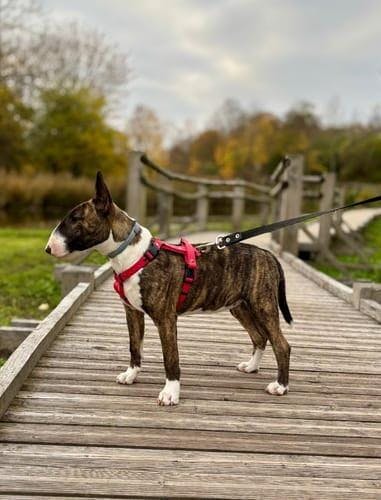
In anatomically correct harnesses, the front strap does NOT go horizontally across the chest. It goes under these shoulder joints - through the belly area. And the top strap goes over the shoulders from above. Result - those joints are free. The dog can move normally.
And it sounds so simple when I write it, but trust me, in a store when you're standing in front of a shelf with twenty different harness models, it's not that clear. I myself bought the wrong harnesses for my dog the first time. They looked great, price was reasonable, seemed fine. Only after a while I noticed the dog was walking kind of... weird. With shorter steps. And then I remembered that conversation about shoulder joints and checked - yep, those were exactly the wrong model harnesses.
Then I bought new ones. And again - not the right ones. The third time I actually took the time to check before putting them on the dog. Shoulder joints free? Yes. And you know, the difference was immediately visible. The dog walked with full, natural strides.
But even here, it's not over. Because even with correct harnesses, there are still nuances.
How to Choose the Right Harness? (Yeah, It's More Complicated Than You'd Like)
Here's why I can't just say - go buy anatomically correct harnesses and you're good. Because even in the right category, different dogs need different things.
I've seen dogs where one harness is perfect, but the same model harness on another dog is completely wrong. And it's because... well, dogs are different. That sounds obvious, but in practice it means you really need to think and look.
What's Worked for Me
When I go to a store (or order online, but then I definitely need a return option), I look for:
First - does that front strap go horizontally across the chest? If yes - I set it aside. Even if they're the most beautiful harnesses in the world. Even if they're 50% off. No.
Second - can my dog move normally? I just walk around with them a bit in the store or at home. I watch if they're walking with normal strides. If nothing's rubbing. If nothing's in the way.
Third - can I fit my fingers under the straps? If the straps are so tight you can't fit two fingers under them, then either it's the wrong size or just not the right model for this particular dog.
Fourth - does the belly strap touch the armpits? Because if it does, walking will create friction, and that's no good.
And yes, I've had it where I bought harnesses that seemed right, but after a week of use realized they weren't. And had to buy new ones. That's just how it is - sometimes you have to try.
I now have anatomically correct harnesses for both my dogs, and they've been wearing them for years. And... well, I don't see any problems. They run, jump, play, go on walks, everything's fine. Are these the absolutely perfect harnesses? I don't know, maybe even better ones exist somewhere. But these work, and I'm satisfied.
My Personal Experience
Alright, now specifically about what I've seen and experienced.
Fifteen years with dogs - that's quite a long time. I haven't counted how many dogs I've met, but... many. Many hundreds. Maybe thousands if you count everyone - in training, consultations, just on walks, friends, acquaintances.
And here's the interesting part. That whole argument about "harnesses pull elbows out" and "backs get crooked" - I really heard that for many years. But when I started really looking - I can't remember. Not a single dog. Not one I could say - yes, this one has a crooked back or wrong elbows specifically because they walked in a harness.
Maybe they exist somewhere. I won't say they don't. But if they do, they're such rare cases that I just don't know about them.
But esophagus damage from collars? Oh, I know about those. I know several dogs - I can name them specifically - who've had problems. Chronic coughing. Difficulty swallowing. And all of them - every single one - are dogs that constantly pull forward on a collar. It's not a scientific study, it's just what I've seen, but... well, I've seen it.
And so I made a decision. Both my dogs - Obi and the other one - have been wearing harnesses since two months old. Not because I want to prove something. Simply because I think it's safer and healthier. And... well, they're healthy. They run, jump, play, everything's normal.
Does that mean I'm one hundred percent sure I'm doing it right? No. I'm neither a vet nor a physical therapist. But I've listened to what those who are say, and I've looked at dogs, and I think harnesses are the better choice. That's why I do it.
One More Bonus (Small but Nice)
There's one more thing that's not directly about health, but is just... convenient.
If you walk with a long lead (and I assume most people do), then a lead that's attached to a harness on the back tangles way, WAY less around the dog's legs. It's just how it's attached - up on the back, not in front at the neck.
I hadn't even thought about it until one day I noticed I wasn't walking around the dog untangling the lead every couple minutes anymore. It's one of those tiny, everyday bonuses that just makes walks a bit more peaceful.
Comparison Overview
To make it easier to decide, I've compiled the main pros and cons of both choices:
Collar
Pros:
- Easy to put on and take off
- Cheaper option
- Works for light walk control if dog walks perfectly at heel
Cons:
- All load concentrates on neck and throat
- Risk of damaging esophagus
- Creates tension and discomfort with pulls
- Can cause injury in extreme situations
- Lead tangles more easily around legs
Harness (Anatomically Correct)
Pros:
- Load distributes across entire body
- Safer in traumatic situations
- Doesn't harm neck and throat
- Doesn't affect natural range of motion
- Lead tangles less
- Better control for larger or stronger dogs
Cons:
- More expensive than collar
- Takes time to find suitable model
- Slightly longer to put on and take off
- Incorrectly chosen harnesses can restrict movement
What Do I Think About All This?
Okay, I've now told you all this, but what's my own conclusion?
I think harnesses are the better choice. Anatomically correct harnesses. Yes, it'll take time - walking through stores, trying them, maybe buying the wrong ones first, then returning and buying different ones. It's a bit annoying, I get it. But... well, you already have a dog. If you're ready to walk them outside twice a day for the next fifteen years, you can spare a couple hours to find decent harnesses.
And it's not just about "harnesses are better." It's about collars seeming risky to me. Even if your dog has never had problems, even if they walk perfectly at heel - a situation can happen. Another dog. A car. Something. And in that moment, it's better if the load goes to the body, not the neck.
But - and this is important - I'm not an expert. I'm a person who works with dogs and who's listened to physical therapists and vets. And based on what I've seen and heard, I think harnesses are better. But you might think differently, and that's okay.
The only thing - if you choose harnesses, PLEASE make sure they're anatomically correct. Because the wrong ones really can cause problems. And then people say "see, I told you harnesses are bad," but actually the problem is that specific incorrect model.
And Finally
I know this topic is... well, confusing. Because there's no one clear answer, and even more - the answer has changed over time. What I was told fifteen years ago isn't what I'm being told now.
And maybe in fifteen years there'll be something new again. Maybe it'll turn out I was wrong again, and there'll be some even better way. And that's okay. That's normal. Science evolves, we learn.
But with what I know now, I think anatomically correct harnesses are the right choice. And I hope this story about how I got there will help you decide what's best for your dog.
Because in the end - we all want the same thing. For our dogs to be well, to be healthy, to be able to run and jump and live full lives. And if correctly chosen harnesses can help with that, then... well, why not?
Frequently Asked Questions About Dog Harnesses and Collars
Can Harnesses Damage a Dog?
Anatomically incorrect harnesses can restrict a dog's natural movement if they block the shoulder joints. However, anatomically correct harnesses that don't cover the shoulder joints don't cause skeletal deformities. In fifteen years of experience working with dogs, I haven't seen a single case where anatomically correct harnesses caused damage to a dog's skeleton or muscles.
Can You Use a Collar on a Dog?
Collars can be used on dogs that never pull and walk perfectly at heel. However, even the most obedient dogs can encounter situations requiring a quick correction (for example, to avoid danger), and in that moment all the load concentrates on the neck and throat, which can create risk of injury. I've seen many dogs with damaged esophagus specifically from collars.
From What Age Can You Put a Harness on a Puppy?
Anatomically correct harnesses can be used from 2 months of age when a puppy comes to their new owner. There used to be a belief that harnesses damage the skeleton until one year of age, but this myth isn't based on facts. The important thing is to choose specifically anatomically correct harnesses that don't cover the shoulder joints.
How Do You Recognize Anatomically Correct Harnesses?
In anatomically correct harnesses, the front strap does NOT go horizontally across the chest. It goes through the belly area, under the shoulder joints. The top strap goes over the shoulders from above. As a result, both shoulder joints remain free and the dog can move naturally. If you see in the store that the front strap goes horizontally across the chest and covers the shoulder joints - those are anatomically incorrect.
Do Harnesses Pull Out a Dog's Elbows?
This is one of the most common myths. In fifteen years working with hundreds of dogs, I haven't seen a single case where anatomically correct harnesses caused elbow or back deformities. If a dog has skeletal problems, they're usually related to the dog's own anatomy, not harness use.
Why Are Collars Dangerous for Dogs?
Collars concentrate all the pulling force on one small area - the neck and throat. This can damage the esophagus, trachea, cause pain and chronic problems. Puppies learning to walk on a leash often start walking with a permanently tense neck, anticipating the next yank. Additionally, collars are more dangerous in extreme situations requiring a sharp pull.
How Much Do Harnesses Cost?
Harnesses are usually more expensive than collars - good anatomically correct harnesses can cost from $20-30 to $60+ depending on size and quality. However, it's a one-time investment in your dog's health. Compared to potential vet costs for treating esophagus or trachea damage, quality harnesses are a cheaper choice.
How Do You Get a Dog Used to a Harness?
Most dogs adjust to harnesses quickly. Start by putting the harness on at home and giving your dog a treat. Let them walk around with it indoors. First walks with the harness should be short and positive. If your dog is already used to a collar, simply switch gradually - start with short walks in the harness, then longer ones.
Do Large Dogs Need Special Harnesses?
Yes, large dogs need stronger and wider harnesses that will distribute the load over a larger surface. However, the most important thing isn't size, but whether the harness is anatomically correct for that specific dog. For large breed dogs with a wide chest, padded versions usually work, but dogs with a narrower build might do better with unpadded ones.
Can You Use a Collar and Harness at the Same Time?
For walks, there's no need to use both at once. If you use a harness for walks, you can keep the collar only for wearing ID tags. Never attach the leash to both simultaneously - this can create unnecessary strain and isn't functional.
How Do Harnesses Affect Dog Training?
Harnesses don't negatively impact dog training. On the contrary - with harnesses it's easier to control large or strong dogs because you're controlling the whole body, not just the neck. The dog also doesn't feel pain or discomfort that could demotivate them or create negative associations with walks and training.
Do Harnesses Work for All Dog Breeds?
Anatomically correct harnesses work for all breeds, but the specific model needs to be adapted to the dog's build. For example, dogs with short muzzles (bulldogs, pugs) might need different harness types than dogs with long muzzles. The important thing is to find a model that doesn't restrict shoulder joints and doesn't touch the armpits.
How Often Should You Replace a Harness?
Harnesses should be replaced when they become too small (for puppies during growth), if they're worn out, or if there's visible damage to straps or buckles. For an adult dog, quality harnesses can last several years. Regularly check that straps aren't worn and all buckles work properly.
Do Harnesses Reduce a Dog's Pulling?
Harnesses themselves don't reduce pulling - that's a training issue. However, with harnesses it's easier to train a dog not to pull because you can better control the dog's body and the dog doesn't feel neck pain that could upset them or encourage even more pulling. There are also special "no-pull" harnesses with a front attachment point.
How Do You Properly Put a Harness on a Dog?
First, loosen all the straps. Pull the head part over the dog's head (for some models). Then wrap around the chest/belly and fasten the buckle on the back. Check that you can fit 2 fingers under each strap - this tells you they're not too tight. Check that shoulder joints are free and the belly strap doesn't touch the armpits.
Do Professionals Recommend Harnesses or Collars?
Currently, most veterinarians, surgeons, and physical therapists recommend anatomically correct harnesses as a safer and healthier choice. There are still some professionals who believe collars are better, but they're in the minority. The opinion has changed in recent years based on practical observations about injuries and their causes.
Share:
Why do dogs tend to be aggressive